
YouTube Video Ads 101: A Practical Guide for Businesses
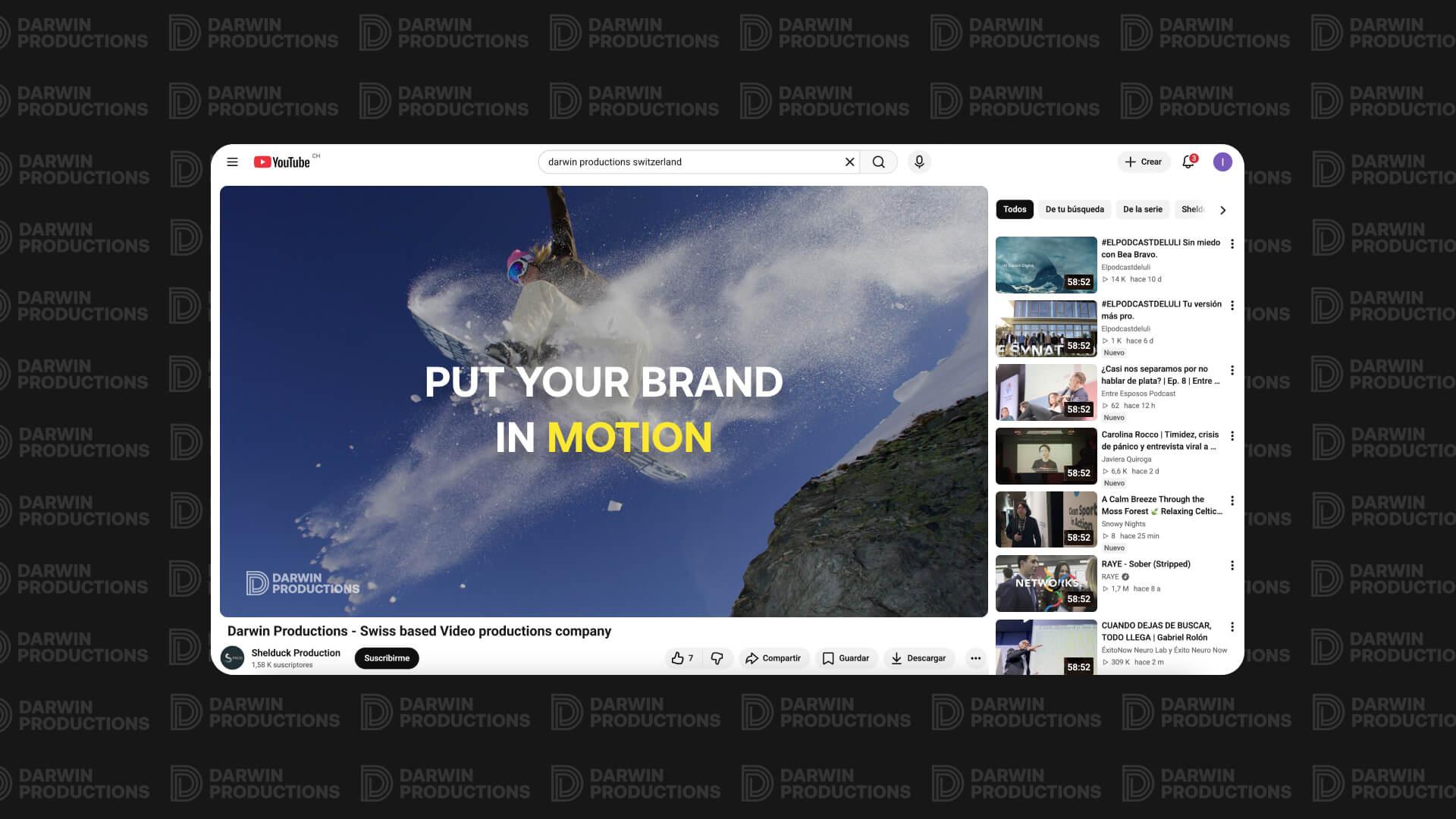
YouTube offers Swiss businesses unparalleled video advertising reach and intent-driven context. This guide covers all formats, when to use each one, what they cost, and how to measure what truly matters.
Why YouTube Ads Deserve a Place in Your Media Mix
If you are a Swiss company deciding where to allocate your video budget, YouTube is hard to ignore. With over 2.53 billion people reachable through its advertising platform, it is where your customers are already spending time—averaging nearly 49 minutes per day.
Switzerland is among the global markets with the highest CPM rates on YouTube, reflecting strong advertising demand and a highly engaged audience. Business results confirm this: 70% of people have purchased a product after seeing it on YouTube.
What distinguishes YouTube from display or social media advertising is the viewing context. People come to YouTube with intent: to learn, to find information, or to be entertained. A well-executed video ad production placed in this environment does not interrupt—it contributes. This is a significant advantage if your creative content is worth watching.
YouTube Ad Formats—What They Are and When to Use Them
YouTube offers more ad formats than any other video platform. This is an asset, but it is also where most advertisers go wrong. Choosing the wrong format for your objective wastes budget and produces misleading results. Here is what each format does and when it justifies its place.
Skippable In-Stream Ads
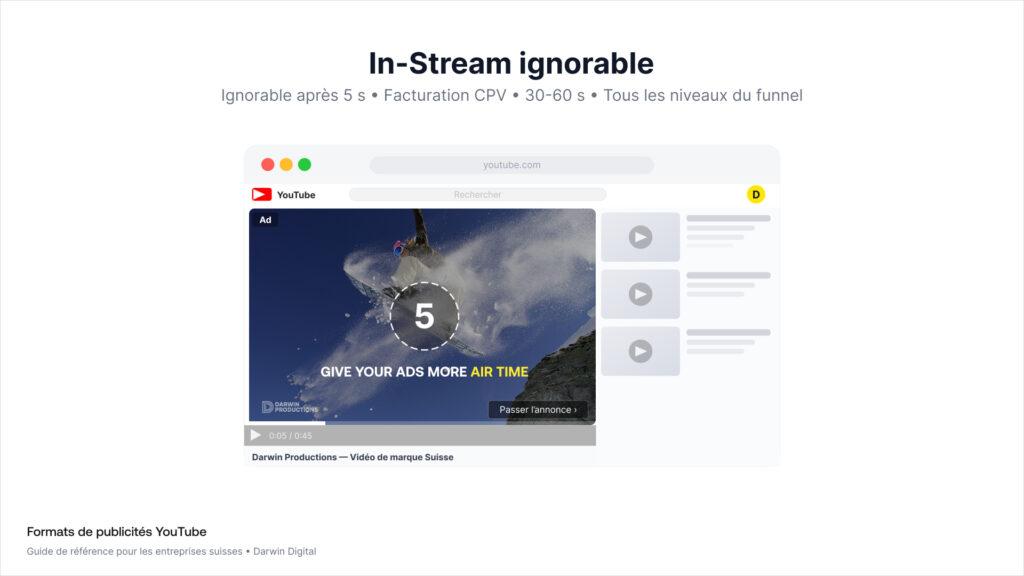
These are ads that play before, during, or after a video, with a “Skip Ad” button appearing after 5 seconds. You are only charged when a viewer watches at least 30 seconds (or the full ad if it is shorter) or clicks. This means every skip before the 30-second mark costs you nothing—yet your brand has still been seen.
Skippable ads are the platform’s most versatile format. They work for awareness, consideration, and conversion goals, and they give you the space to tell a real story. The recommended minimum length is 15 seconds; most top-performing skippable ads run between 30 and 60 seconds.
Non-Skippable In-Stream Ads
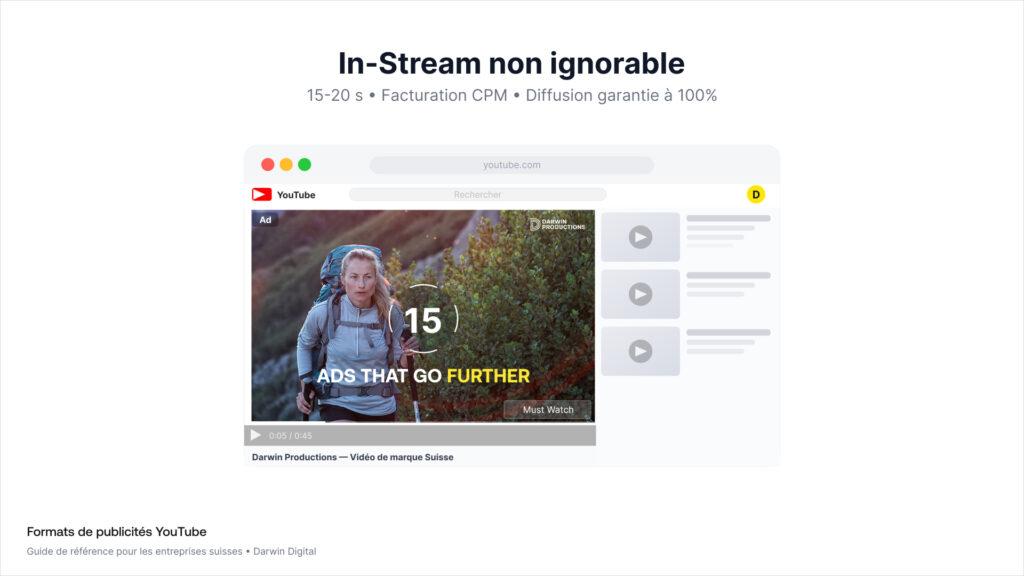
Viewers must watch these in their entirety before their content begins. They last up to 15–20 seconds and are charged on a CPM basis: you pay per thousand impressions, not per view. This guaranteed delivery makes them powerful for time-sensitive messages or product launches where you need every viewer to receive the full message.
Use them sparingly. Forced viewing can generate negative sentiment if the creative content is not strong enough to justify the interruption.
Bumper Ads
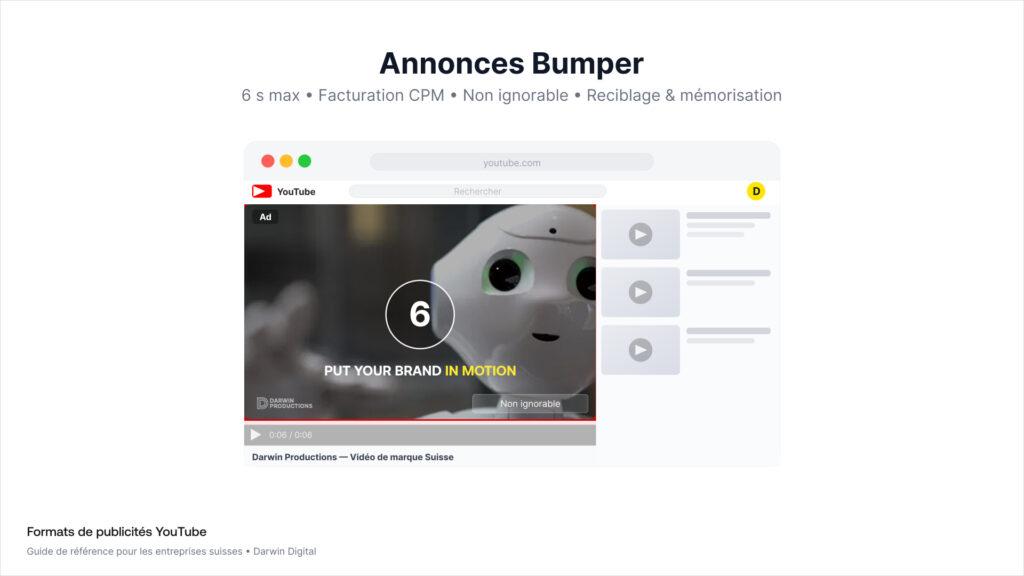
Six seconds, non-skippable, charged on a CPM basis. Bumper ads are not designed to tell a full story: they are built for one idea, one message, one impression. They excel at reinforcing an ongoing campaign, retargeting people who have seen a longer ad, or maintaining a low-cost brand presence between larger campaigns.
In-Feed Video Ads
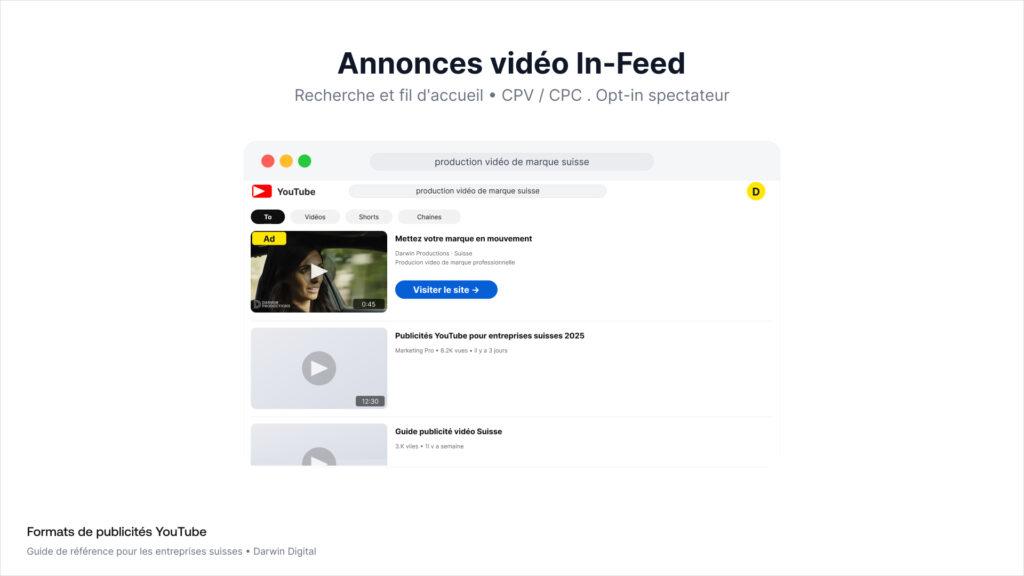
These appear in YouTube search results, on the home feed, and alongside related videos—as a thumbnail and headline that users choose to click. You only pay when someone actively decides to watch. This opt-in intent makes In-Feed ads particularly effective for longer educational content where the viewer is already curious.
YouTube Shorts Ads
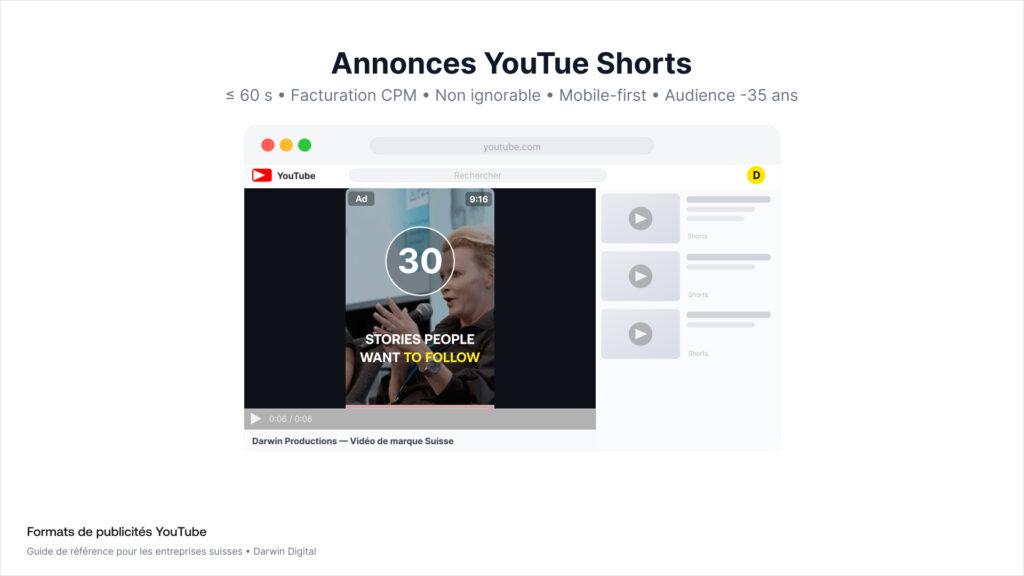
Shorts surpassed 200 billion daily views worldwide in 2025 and continue to grow rapidly, especially among audiences under 35. Shorts ads are vertical (9:16), non-skippable, last up to 60 seconds, and appear between organic Shorts in the feed. The viewer mindset is fundamentally different here: people scroll quickly and decide to keep watching within 2 seconds, not 5. Vertical content created specifically for this format consistently outperforms repurposed landscape videos by up to 3x in terms of completion rates.
Masthead Ads
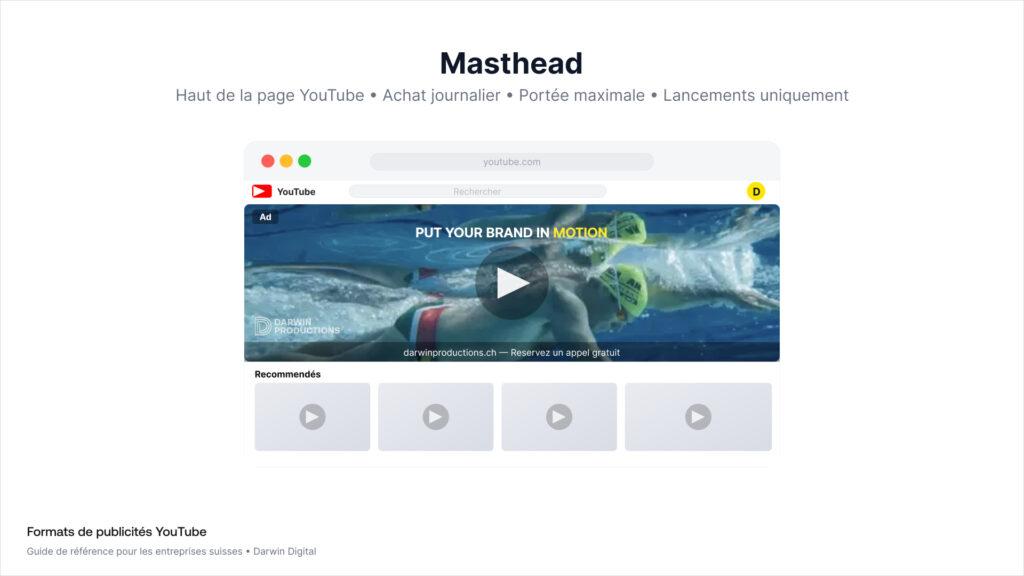
The Masthead appears at the top of the YouTube home page on desktop and mobile: a high-visibility premium inventory, usually sold on a daily basis. This is not a format suited for most campaigns. It is reserved for major product launches, national announcements, or brands with the budget to dominate a news cycle. If this is not your situation, other formats will serve you better.
How to Match the Right Format to the Right Funnel Stage
Choosing the right format starts with one question: what do you need someone to do after seeing this ad? Each format has a natural place in the buyer’s journey.
Awareness: You want to be seen and remembered. Bumper ads and non-skippable In-Stream ads are your tools here. They guarantee delivery, maintain a low cost per impression, and work well at scale. Masthead ads also fall into this category for campaigns with the budget to support them.
Consideration: You want people to seriously think about what you are offering. Skippable In-Stream ads give you the time to make your case: demonstrate a product, share a customer testimonial, or explain a service. In-Feed ads work well here too, reaching viewers who are actively searching for something relevant.
Conversion: You want action: a click, a completed form, a purchase. Skippable In-Stream ads delivered via Google’s Demand Gen campaigns (which replaced Video Action campaigns in 2025) are the primary format for driving a direct response. Retargeting viewers who watched 50–75% of a previous ad with a conversion-focused follow-up is one of the most effective tactics available.
A practical starting point for most businesses: run skippable In-Stream ads for mid-funnel reach, layer on Bumpers for retargeting, and test Shorts if your audience is younger or primarily mobile. You don’t need every format at once. You need the right format for the stage your audience is in.
The Creative Content is the Campaign—How to Create an Ad That Truly Holds Attention
Here is an uncomfortable truth about YouTube advertising: targeting puts your ad in front of the right person, but the creative content determines if they care. According to Google’s internal data, creative quality accounts for 70–80% of a campaign’s effectiveness. The best media strategy in the world cannot save a weak video.
This is where most businesses under-invest, and where professional video production pays for itself.
The First Five Seconds
On skippable ads, viewers decide whether to stay or skip before the 5-second mark. These seconds don’t just affect engagement: they determine your entire campaign ROI.
What works in those first 5 seconds:
- A hard-hitting question that speaks directly to a problem your audience is facing
- An unexpected visual or a pattern interrupt that breaks the scrolling reflex
- A specific, data-driven statement (“Most businesses lose 30% of their leads here”)
- A recognizable scene that immediately signals “this is for you”
What does not work: a logo animation, a slow fade-in, or “At [Company], we believe that…”. Starting with your brand name before you have captured attention instantly triggers the skip reflex.
An important nuance: ads that naturally establish a brand presence within the first 5 seconds—not in a forced way, but integrated into the hook—tend to show significantly higher view rates than those that save the branding for the end. You aren’t hiding your brand; you are integrating it early.
Structure of a 30 to 60-Second Ad
For skippable In-Stream ads lasting 30 to 60 seconds, Google’s research indicates a structure that consistently outperforms:
- Seconds 0–5: Hook—capture the viewer during the skip window
- Seconds 6–15: Context—establish the problem and why it matters
- Seconds 16–45: Proof—a customer testimonial, a demonstration, or a concrete result
- Seconds 46–60: CTA—a clear next step, with a reason to act now
The proof section is where most ads fail. “Our customers love us” is not proof: it is a claim. “A Lausanne-based startup reduced their onboarding time by 60% in 30 days using this” is proof. Specificity converts.
Your CTA must be just as precise. “Learn more” underperforms compared to “See how it works” or “Book a free call.” Give people a concrete, low-friction action.
Production Quality vs. Authenticity
High-quality production is important, but it is not the only path to a high-performing ad. For direct response goals, authentic, lo-fi creative content often outperforms polished brand films because it reduces viewer skepticism. What never changes, regardless of budget: audio quality, a hard-hitting hook, and a clear CTA.
For brand campaigns and product launches—or any situation where first impressions matter—a professionally produced video signals credibility before a word is even spoken. The choice between high-end and lo-fi is not a matter of budget; it is a matter of what your audience needs to trust you.
What YouTube Ads Cost—and How to Budget
YouTube uses two primary pricing models depending on the format:
- CPV (Cost Per View): Used for skippable In-Stream ads. You pay when someone watches 30 seconds or interacts. The average CPV is CHF 0.05 to 0.10 for broad audiences; B2B targeting typically ranges between CHF 0.12 and 0.25 due to smaller, more competitive audiences.
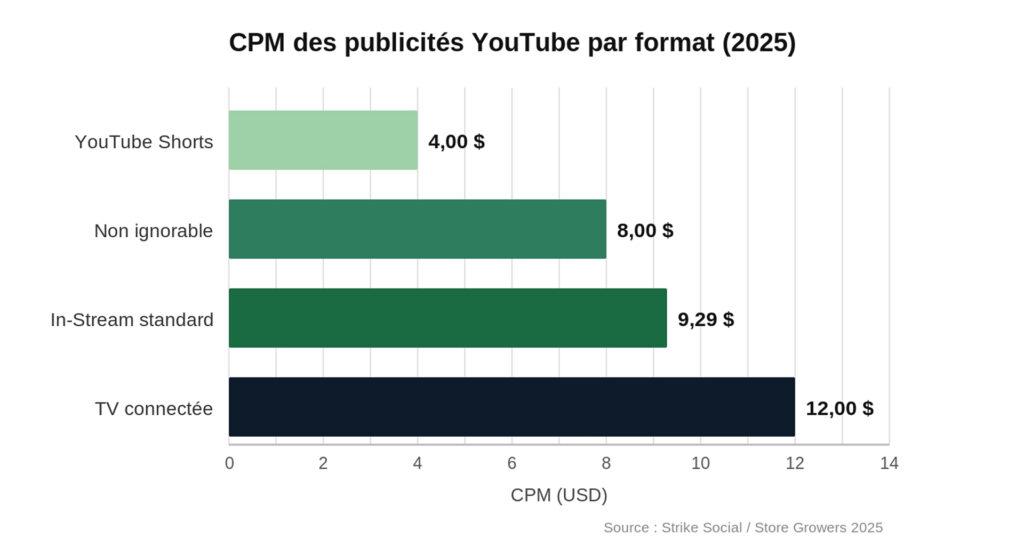
- CPM (Cost Per Mille/Thousand Impressions): Used for non-skippable, Bumper, and Shorts ads. Global averages are around CHF 9 for standard video formats; Shorts CPM is lower, around CHF 4. Switzerland, one of Europe’s top-performing advertising markets, sits above the global average: expect CPMs between CHF 7 and 12 depending on targeting and format.
Some practical budgeting realities:
Minimum Viable Testing Budget: Plan for at least CHF 1,500 to 3,000 per month to generate enough data to make decisions. Below this threshold, you won’t have enough impressions to know what is working.
Seasonal Costs: Q4 (October–December) CPMs are 25–40% higher due to increased competition among advertisers. If your campaign is not tied to the holiday season, a launch in January–February or July–August will give you significantly lower costs.
B2B Campaigns Cost More: Targeting decision-makers at specific companies narrows your audience considerably. Expect to pay 1.5 to 2 times the generic CPV benchmark, but the quality of reach justifies it.
You Get Free Exposure from Skips: Every viewer who watches 4 seconds and skips has still seen your brand. If your logo and core message appear in the first 5 seconds, you are extracting value even from people who don’t watch further. This changes how you view the true cost per impression.
The Metrics That Matter
View Rate: The percentage of impressions that turned into views (30 seconds or more watched). The industry average is 31.9%. Below 25%, your hook usually isn’t working or your targeting is off. Above 45% is solid. This is your primary creative health metric.
CPV (Cost Per View): What you pay each time someone watches. A good benchmark for TrueView ads is CHF 0.015 to 0.025. Above CHF 0.04 usually signals poor relevance or narrow, competitive targeting. Watch CPV trends over time: a rising CPV on the same audience often means creative fatigue.
CTR (Click-Through Rate): The number of viewers who clicked your CTA. The global YouTube benchmark is around 0.65%. CTR is most relevant for conversion-focused campaigns; for awareness campaigns, a low CTR doesn’t mean the ad isn’t working—brand recall and view-through conversions matter more here.
View-Through Conversion Rate: Conversions attributed to people who saw your ad but did not click. This is often the most undervalued metric on YouTube. Someone watches your ad, doesn’t click, then searches for your brand or visits your site later. This journey is real and measurable. Ignoring it leads to undervaluing the platform entirely.
A practical note: do not evaluate a YouTube campaign on CTR alone as you would a search campaign. YouTube builds awareness and consideration that convert later—sometimes days or weeks after the viewing. Measure accordingly.
Common Mistakes to Avoid
Even well-funded campaigns get these points wrong.
Wrong Format for the Objective: Running a 6-second Bumper ad to drive direct conversions, or a 60-second skippable ad solely for awareness, wastes budget and produces misleading data. Start with your goal, then choose the format.
No Hook: The most common reason campaigns underperform. If your ad starts with a logo, a slogan, or a slow brand intro, most viewers are gone before the skip button even appears. The hook is not optional.
Ignoring Shorts: YouTube Shorts is the fastest-growing format on the platform and still has less ad competition than standard In-Stream ads. If your audience includes people under 35 or heavy mobile users, not testing Shorts is leaving cheap, high-engagement inventory on the table.
No Retargeting Strategy: Someone who watched 75% of your video ad is warm. They know who you are. Showing them the same awareness ad again is a missed opportunity. Build a follow-up sequence—a more specific offer, a testimonial, a direct CTA—and target viewers by view percentage.
Frequency Creep: Showing the same ad to the same person repeatedly creates annoyance, not awareness. Set frequency caps and rotate creative content regularly. Creative fatigue is real and shows up quickly in rising CPVs and falling view rates.
Measuring Only Clicks: As mentioned above, YouTube’s value often lies in brand recall and view-through conversions. If your measurement setup only captures direct clicks, you are giving other channels credit for results that YouTube quietly generated.
FAQ
Do I need a large budget to run YouTube ads in Switzerland? No. You can start testing with as little as CHF 10 to 20 per day. That said, plan for at least CHF 1,500 to 3,000 per month to gather enough data to make meaningful decisions. Below this threshold, results will be too thin to optimize.
How long should my YouTube ad be? It depends on the format and goal. For skippable In-Stream ads, 30 to 60 seconds works well for consideration and conversion. Bumpers are limited to 6 seconds. For Shorts ads, aim for under 30 seconds with a hook in the first 2 seconds. In 2024, 44% of top YouTube ads deviated from standard 15/30/60-second lengths: let your story determine the length, not convention.
Can I run YouTube ads without a video production team? Technically yes, but creative quality determines 70–80% of campaign performance. A poorly produced video with good targeting will still underperform compared to a well-produced video with average targeting. For brand campaigns, explainer videos, or any ad where trust is the goal, working with a video production team makes a measurable difference.
What is the difference between CPV and CPM on YouTube? CPV (Cost Per View) means you pay when someone watches at least 30 seconds of your ad—used for skippable In-Stream formats. CPM (Cost Per Mille) means you pay for every 1,000 times your ad is served, whether it is watched in full or not—used for non-skippable, Bumper, and Shorts formats.
How do I know if my YouTube ad is working? Track the view rate (aim for 31.9%+), CPV (benchmark CHF 0.015–0.025), and view-through conversion rate. Do not rely on CTR alone: YouTube influences decisions that often convert later via direct search or branded traffic.
Conclusion
YouTube video advertising is one of the most powerful tools available to Swiss businesses—but only when format, creative content, and measurement are aligned. Choose the wrong format and you waste your budget. Neglect the hook and you lose your viewers before they’ve seen anything. Ignore view-through conversions and you will undervalue the channel entirely.
Businesses that succeed on YouTube treat it for what it really is: a storytelling platform. The ad that captures attention, makes a specific case, and gives viewers a clear next step—that is the one that converts. Everything else is just spending money on impressions.